A Passover Conversation in Four Voices

Four conversed about the pine tree.  One defined it according to genus, species and variety.  One held forth concerning its shortcomings in the lumber industry.  One quoted verses about pine trees in numerous languages.  One struck root, stretched out branches and rustled.

(Click here for the Pagis poem in Hebrew and English)

In his prose poem called Sicha (Conversation), Dan Pagis gathers four characters, beginning with one who scientifically classifies and ending with one who does not speak. His scene suggests a similar ancient Passover gathering described in the Haggadah:

The Torah speaks about four children—one who is wise, one who is wicked, one who is simple, and one who does not know how to ask.

The Torah does not explicitly tell a story about four children. Rather, three times the Torah anticipates that children will ask questions about Passover; a fourth child is instructed, although no question is actually asked.

(Click here for the Haggadah’s Four Children in Hebrew and English)

Ancient sages were sensitive to this unique parent-child instruction in the Torah that foresees a gap developing between Passover ritual and reason. Based upon the biblical give and take, they constructed a character for each child and then assembled those four at the Passover Seder.

(Click here for the Biblical Voices in the conversation)

The Haggadah project of assembling the Torah’s four children had its own limitations. The biblical exchanges would only allow so much nuance and flexibility for the Haggadah’s script. Over the course of time, types tended towards stereotypes.

The wise child’s inquiry into laws and rules garnered praise. The wicked child’s question about the ritual’s meaning to you earned him a harsh answer in kind that excluded him from the community that the Haggadah insists he has disowned. The third child’s simple question, What is this? elicited a simple, condensed exodus narrative. He was readily identified as naïve and innocent, lacking a capacity for more than a simple, straightforward answer. The child without words is easily seen as a very young child.

The Jerusalem Talmud, at least as old as the Haggadah, already resisted such stereotypes by reversing the answers given to the wise and to the simple child. In so doing, this ancient version of the story implicitly asked:  Is there such a thing as a wise or a simple question?  Perhaps a question is shaped, strengthened, even redeemed by the response.

(Click here for the Jerusalem Talmud’s four children)

Pagis’ poem renews the challenge to re-imagine the four. Each participant in the poem offers a commentary on his Haggadah counterpart.

The first participant occupies the wise child’s place of privilege. His technical knowledge is his wisdom. The one with the sharp and critical eye tests assumptions about what it means to be “wicked.” Pagis’ third character lives in a world of language and verse—a “simple” world that is neither naïve nor unsophisticated.

The final personality is profoundly “rooted” in the subject of the pine tree. His being, his “pining,” is his stand; presence, not presentation is his eloquence.

The poem’s title, Sicha, creates a certain tension with the poem, itself. Does Conversation capture the action of the poem? After all, the poem’s characters do not speak to one another. Just, so, the four children of the Haggadah do not speak to one another. Perhaps the title, Conversation, carries the hope for what might follow once all participants are honored for their presence and for their potential.

(Click here for a related post on the Haggadah’s four children)
Posted in Holidays, Passover, Poetry, Talmud | Leave a comment

Kindness, Not Sacrifice

Lonely and painful winter days invite nostalgia for days of hesed—days of loving kindness and compassion. So says the poet, Yehuda Amichai:

“Those were days of hesed,” I heard them say once
on a winter street during days of loneliness and pain.
Even for days of hesed we need at least two,
one to give hesed and one to receive it.
When they are separated the hesed does not abide
or it is spilled into the street as if from a broken pipe.

Religions do not do hesed, they only remind
empty time, with a bell, with a muezzin’s call,
with a siren or a shofar, with knocks on the door
during days of penitence:  God they are
unable to remind or his hesed.

Since the day that sacrifices ended
Each person is left himself
To sacrifice.

(Click here for Amichai poem in Hebrew and English)

It stands to reason that a world without hesed is cold and lonely. After all, hesed requires community. Without people to give and to receive, hesed vanishes or leaks away, a useless spill. Hesed is the work of people in community. For Amichai, religions are but frameworks for hesed.  By all evidence, God is indifferent to hesed and his attribute of hesed remains distant. The ritual connection of God above and people below—sacrifice—does not have the impact of hesed’s human connection.

Hesed is not in heaven.  It is as grounded as a water pipe, plumbing the human depths of need and responsibility.

According to Amichai, hesed does promote sacrifice, but not ritual sacrifice to God:  Since the day that sacrifices ended, each person is left himself to sacrifice. It is self-sacrifice, the giving of oneself, that is a feature of hesed. Says a modern Jewish philosopher:  Self-sacrifice for another individual, value, or collective seems key to much of ethical life. (Moshe Halbertal, On Sacrifice).

Both philosopher and poet are consistent with an ancient teaching that the ruined Temple’s ritual sacrifice to God has been effectively replaced by hesed’s sacrifice for the sake of community:

Once, Rabban Yohanan ben Zakkai was leaving Jerusalem and Rabbi Yehoshua, who was walking with him, took note of the ruined Temple. Said Rabbi Yehoshua:  Woe is us on account of that which is ruined, that place in which we might atone for the sins of Israel! Rabban Yohanan ben Zakkai replied:  My son, do not be troubled. We have another means of atonement that is its like. And what is that?  Gemilut hasadim/deeds of kindness, as it is said: For I desire hesed/kindness, not sacrifice (Hosea 6:6).

(Click here for midrash in Hebrew and English)

In a world without the Temple and its altar-atonement, it is hesed—kindness and compassion—that offers community the possibility to renew an open ended future.

Posted in Midrash, Poetry | 1 Comment

Divine Gaze

After the fiasco of the golden calf, a resentful God said to the pleading Moses: You cannot see my face, for no one can see my face and live (Exodus 33:20). So says one ancient story teller:

It was taught in the name of Rabbi Yehoshua ben Korhah that the Holy One spoke to Moses this way:  When I wanted you to look, you did not want to. Now that you want to, I do not want it.

Perhaps Rabbi Yehoshua imagined that God had been brooding ever since Moses hid his face from the burning bush (Exodus 3:3).  How could Moses snub an invitation to encounter God face to face?

Rabbi Shemuel disagreed with Rabbi Yehoshua. He insisted that Moses had acted correctly by hiding his face from the burning bush. In fact, the Torah records three rewards for Moses’ act of hiding his face, one reward for each aspect of reverence captured in Exodus 3:6—And Moses hid his face/ for he was afraid/ to look at God. One word in each part of that verse tallies with each reward:

Rabbi Shemuel bar Nahmani taught in the name of Rabbi Yonatan:  As a reward for three acts Moses merited three things. As a reward for ‘Moses hid/va-yaster his face’ (Exodus 3:6), Moses merited a radiant face/k’laster after being in God’s presence on Sinai. As a reward for ‘he was afraid/yarei (Exodus 3:6), Moses merited that the people were ‘afraid/yire-u to approach him’ when he came down from the mountain, his face aglow (Exodus 34:30). As a reward for ‘Moses specifically being afraid to look/mei-ha-beet at God’ (Exodus 3:6), he merited ‘seeing/ya-beet the likeness of the Lord’ (Numbers 12:8).

(Click here for Talmud story in Hebrew and English)

The Israeli poet, Yehuda Amichai, brings another voice to the conversation. Amichai agrees that Moses should not have hidden his face. But the poet tells the story of Moses’ regret, not God’s. True, Moses was commanded to stand his distance and shed his sandals. But it was Moses’ own idea to hide his face. From that moment on, says the poet, it was regret that propelled the career of Moses.

Moses, our teacher, only once saw the face of God
and forgot. He did not want to see the wilderness
not even the promised land, but only the face of God.
He struck the rock in the fury of his longings
he went up and down Mt. Sinai, he shattered the two
tablets of the covenant and made a golden calf, he searched
in fire and cloud. But he remembered only
the strong hand of God and his outstretched arm
not his face and he was like someone who wants
to remember the face of a loved one but cannot.
He made himself a police sketch from the face
of God and from the burning bush and from the face
of Pharaoh’s daughter who leaned over him when he was an infant in the basket,
and he distributed the picture to all the tribes of Israel
and throughout the wilderness. But no one had seen
and no one recognized. And only at the end of his life,
on Mt. Nebo did he see and die
with a kiss from God’s face.

(Click here for Amichai poem in Hebrew and English)

For Amichai, Moses’ career was drawn taut between only once seeing the face of God at the burning bush and only at the end of his life seeing it, again. The Torah records the outer story of Moses’ inner quest. It was a personal search that impelled him up the mountain. With dashed hopes of seeing God’s face again, he shattered the tablets he had gotten there. The poet even imagines that the shattered Moses made his own golden calf to try and give shape to his dim memory. But Moses could neither sculpt nor draw on memories of the face that he was not permitted to see on the mountain.

You cannot see my face, God said to a pleading Moses who climbed the mountain one more time. For Rabbi Yehoshua, this was God’s rebuke; for Amichai, it was Moses’ disappointment. The poet goes on to say that with the second half of the verse, Moses’ search came to an end:  no one can see my face and live. And so it was that only at the end of his life, on Mt. Nebo did he see and die with a kiss from God’s face.


Posted in Parshat HaShavuah, Poetry, Talmud | 5 Comments

Overturning A Mountain of Tradition

An ancient story teller uprooted Mount Sinai and held it threateningly over the people of Israel:

They stood beneath the mountain (Exodus 19:17). Said Rav Avdimi bar Hama bar Hasa, This teaches that the Blessed Holy One vaulted the mountain over them like a barrel and said to them:  If you accept the Torah well and good, and if not, there will be your graves.

The Talmud presents this jarring story side by side with imaginative love-at-first-sight Sinai stories gilded by the Song of Songs, adorned by divine presence and by angels who descended to crown Israel and to celebrate. But this story teller resisted the embellished stories of God and Israel’s mutual love. He insisted upon uprooting the plain meaning of the verse, They stood beneath the mountain, in order to say that Israel was compelled by threat of death to accept the Torah.

(Click here for the Talmud story and an additional contrasting story)

Rav Avdimi’s story elicited surprise from another colleague:  Said Rabbi Ahah bar Ya’akov, This story is a strong indictment against Torah!  But in so lifting the mountain, Rav Avdimi uncovered a foundational truth:  Torah is the single story that tells Israel into being. Without Torah, Israel could not exist. At the very least, Israel could not be the people of this book. The story of the uprooted mountain is a story of necessity—a compelling story.

The Israeli poet, Yehuda Amichai, offers another jarring story about Israel compelled to live with Torah:

When God left the earth he forgot the Torah
at the Jews’ and since then they look for him
and cry after him, you forgot something, you forgot, in a loud voice
and others think that this is the prayer of the Jews.
And ever since they strain to find hints in the Bible
as to the place he might be found as it says, Seek the Lord where he is to be found,
Call upon him when he is close. But he is far.

(Click here for the Amichai poem in Hebrew and English)

Set between the phrases God left and God is far, Amichai portrays the leaving of the Torah at Sinai, not the giving of the Torah. God did not give the Torah; he forgot it at the Jews’ camp in Sinai. Torah is an accidental possession, and the inadvertent recipients feel compelled to return it.

Like Rav Avdimi, Amichai overturns a mountain of tradition and exposes a characteristic of Israel’s life with Torah that, ironically, appears conventional and pious; namely, Israel learns Torah in order to find God. The act of learning and seeking is intense, unending, and prayer-like.

The story teller and the poet agree:  Torah is a compelling force in Israel’s life. God might be threatening or God might be indifferent and far, but Torah is close.

Posted in Parshat HaShavuah, Poetry, Talmud | 2 Comments

Sufficient Meaning?

The Torah’s written words are not sufficient.   It is the reading of the word and not the word alone that produces meaning.  Meaning appears when timely experiences enter into conversation with the timeless text.

Rashi, the great commentator, gives an example of meaning beyond the evidence of the words themselves.  He understands God to be nostalgic, if not exasperated, when saying to Moses:  I appeared to Abraham, to Isaac, and to Jacob as El Shaddai, but by my name, YHVH, I was not known to them. (Exodus 6:3)

In his commentary, the Torah’s meaning overflows the banks of its words when God speaks them to Moses with the following emotional inflection:

What a pity concerning those who are lost and no longer here!  I have good reason to mourn the death of the patriarchs.  Many times I revealed myself to them as El Shaddai and they never asked beyond that:  What is your name?  But you, Moses, said from the very beginning:  Look, when I come to the people of Israel and say to them, the God of your ancestors has sent me to you, and they ask, what is his name, what shall I tell them?  (Exodus 3:13)

(Click here for Torah and Rashi texts in Hebrew and English)

Ancient sages often explained the name Shaddai as meaning enough, sufficient—dai, as in the Passover hymn, Dai-einu/It would have been enough for us.  In Rashi’s reading, El Shaddai was a name sufficient for Abraham, Isaac, and Jacob.  In the sufficiency of that name lies the virtue of the patriarchs and also the admiration of God nostalgic for the days when that name sufficed.  Now, much to God’s chagrin, Moses anticipates that the people will want more.

The name not known to the patriarchs—YHVH—is the opposite of sufficient.  It is a name of possibility composed of letters that look like a form of the verb, “to be.” These letters are sometimes consonants, sometimes vowels.  Sometimes their mere presence indicates a shade of meaning while they remain silent, unpronounced.  This name is fluid, unpronounceable—the guardian of all future names.

The following poem by the Israeli poet, Rivka Miriam, suggests a reading of the Exodus verse in which God is eager for new names:

Midnight.  At the Rabbi’s door
the Creator listens intently
to know
which of His names he will call out tonight
.

(Click here for Rivka Miriam poem in Hebrew and English)

Rivka’s God might say:  My name, El Shaddai, was a name sufficient for its time.  But I listen eagerly to be called and challenged by the new names necessary for new revolutions and revelations.

Posted in Midrash, Parshat HaShavuah, Poetry, Torah | Leave a comment

Is Being Right All That’s Left?

Perhaps I have lived my whole life in a mistake, says the poet, Yehuda Amichai.  The God of my childhood also is a mistake, yet he is still called God.

If history demonstrates that a heroic and sacred vision was short-sighted, are heroes still heroes?  Is God still God?  The tension between belief and mistake propels Amichai’s poem from its first verb, he’emanti/I believed to the concluding Amen/I believe:

When I was young I believed with all my heart that the Hula
swamp had to be drained, but all of the colorful birds
fled and now, after almost half a century,
they are again filling it with water, because it was a mistake.  Perhaps
I have lived my whole life in a mistake.  The God of my childhood also
is a mistake, yet he is still called God.
But a complete mistake makes for a complete life
the same as complete belief.  The words “a mistake lives forever”
I have made into a soothing melody, and from the words
“everyone disappoints” I have made a dance step by day
and a lullaby by night. Amen

(Click here for the Amichai poem in Hebrew and English)

Ancient sages tested the tension between belief and mistake through a Torah verse describing the outcome of an appeal that rises to the highest authorities:  You shall act in accordance with the instructions given you… you must not deviate from the verdict that they announce to you either to the right or to the left.  (Deuteronomy 17:11)

The rabbis pushed this verse to represent the deepest conflict between personal belief and public decision.  In the face of the highest ruling, they say, you must not deviate … even if they tell you that what is right is really left.  In the face of a clear mistake, one must trust a vision that is larger than a point of view.

Sefer Ha-Chinnuch, a 13th century Spanish commentary, adds its voice to the conversation of Scripture and sages:

Even if they [the court] are mistaken in a particular matter among many, it is not our right to break away from them.  Rather, we should act according to their mistaken decision.  It is better to live with a single mistake and leave the tradition in tact than for each individual to act according to his own mind, for that is tantamount to destroying tradition…. From this same commandment we are commanded that the minority party of the sages should defer to the majority party.

(Click here for biblical and rabbinic texts)

The existence of a minority and a majority party proclaims that vigorous debate is of high value.  It is not the case that being right is all that’s left.  Belief, not certainty, launches a future in which the past is always at stake, and complete mistake along with complete belief are regular features of a complete life.  Everyone disappoints, says the poet, bringing a Psalm verse (Psalms 116:11) to strengthen him by day and soothe him by night.  Amen, concludes the poet—this, I believe.

Posted in Poetry | 2 Comments

Fashioning the Fashioner

I say with complete faith
that prayers preceded God.
Prayers fashioned God
God fashioned man
and man fashions prayers
that fashion God who fashions man.

Says the poet, Yehuda Amichai:  Prayers generate the endless cycle of hope and help, of imagination and image, of creator and created.  Amichai’s complete faith satisfies the urge to name a beginning.  But quickly, “endless” becomes more important than “origin.”

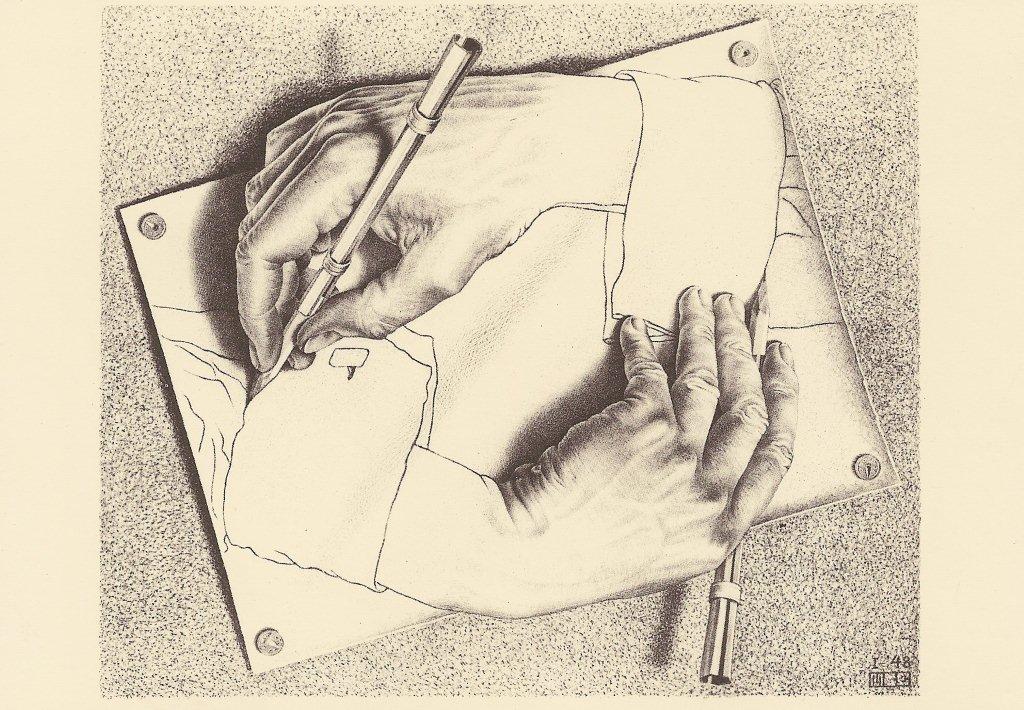
The artist, M.C. Escher, does not name in religious language the deep force that sets fashioning in motion.  He challenges us to reflect upon our own point of complete faith from which everything rises.  He moves us to ask:  What causes the hands to rise off the page, each one fashioning the fashioner?

Drawing Hands by M.C. Escher

Click here for poem in Hebrew and English together with the Escher drawing.

Posted in Poetry, Prayer | 2 Comments

Soul Existence

The late James Hillman (1926-2011) taught that soul is our capacity to make meaning, our ability to deepen events into experiences.  Sustaining and nourishing, soul deepens us and raises us, allowing us to travel inwards and outwards.  With all of the soul’s vitality and mystery, its kinship with God is no surprise:

By soul I mean, first of all, a perspective rather than a substance, a viewpoint toward things rather than a thing itself.  This perspective is reflective; it mediates events and makes differences between ourselves and everything that happens…

It is as if consciousness rests upon… an inner place or deeper person or ongoing presence that is simply there even when all our subjectivity, ego, and consciousness go into eclipse.  Soul appears as a factor independent of the events in which we are immersed.  Though I cannot identify soul with anything else, I also can never grasp it by itself apart from other things….

However intangible and indefinable it is, soul carries highest importance…frequently being identified with the principle of life and even of divinity.  (Hillman, from Re-visioning Psychology)

Ancient talmudic sages spoke of similarities between the soul and God, including the shared feature of being a foundational inner place or deeper person.  For the rabbis, both God and soul dwell in the innermost place/b’haderei hadarim:

In the Psalms, David said five times: Bless the Lord, O my soul!  Why five times?  It was because of five similarities between the Holy One and the soul.  Just as the Holy One fills the entire world, so does the soul fill the entire body.  Just as the Holy One sees but is not seen, so the soul sees but is not seen.  Just as the Holy One sustains the whole world, so does the soul sustain the whole body.  Just as the Holy One is pure, so is the soul pure.  Just as the Holy One dwells in the innermost place, so does the soul dwell in the innermost place.

Let the one possessing these five qualities come and praise the one with these five qualities!  (Click here for Talmud passage in Hebrew and English)

Both the soul and God fill their domains, yet both inhabit the innermost place.  It is there that one image meets the other, one imagines and deeply knows the other.

Hillman might say to each of them, and to us:  When you are in need of an ongoing presence that is simply there, turn to the soul image upon which you can rely.

Posted in Talmud | Leave a comment

The Lulav: Pointing To Creator and Creature at the Season of Creation

It is the manner of earthly monarchs to extend the scepter with favor towards a subject.  During Sukkot, when the lulav becomes the scepter, it is the earthly, earthy subject who extends the scepter with favor towards the horizons and the heavens.  We reach out and draw in the lulav, as if to gather—to sum and to summon—wide abundance.  Each person stands at the center of a circle of reach, pointing now to creator, now to creature, at the season of creation as we prepare to begin the Torah anew.

Rashi, the great commentator of the middle ages, calls attention to the unique place of the human being who points beyond and within,  in whom earth and heaven, dust and spirit, conspire.  Rashi finds his opportunity in the following verse:  The Lord God formed humankind from the dust of the earth; He blew into his nostrils the breath of life and the human became a living being.  (Genesis 2:7)  Rashi says:

He made the human from the earthly as well as from the heavenly:  Body from the earthly and soul from the heavenly.  For on the first day he created heaven and earth.  On the second, He created the firmament on behalf of the heavenly.  On the third day:  let the dry land appear, was for the sake of the earthly elements. On the fourth day He created the lights for heavenly.  On the fifth day: let the waters teem, was for the earthly.  Therefore it became necessary on the sixth day to create something [like on the first day] that combined the heavenly and the earthly.  Otherwise, there would be jealousy among the works of creation.  For either the heavenly or the earthly would have claim to one day more of creation than the other.

(Click here for Rashi text in Hebrew and English)

The Israeli poet, Rivka Miriam, also understands that humankind brings an earthly perspective to the heavens as well as heavenly vision to earth:

In the beginning God created
the heavens that in essence are not
and the earth that wants to touch them.

In the beginning God created

threads stretched between them

between the heavens that in essence are not

and the imploring earth
And humankind he fashioned
such that a person is a prayer and a thread

touching that which is not

with a touch soft and delicate
.

(Click here for the Rivka Miriam poem in Hebrew and English)

It is the human being who prays and threads the distance between heaven and earth.  Perhaps the heavens in essence are not.  Nevertheless, it is the human reach towards abundance and beyond that makes the heavens real.

Posted in Holidays, Midrash, Parshat HaShavuah, Poetry | 4 Comments

Temporary Shelter

Twice a year the Jewish calendar offers the invitation and challenge to see the world differently.  During Pesah, everything that was kosher the day before is no longer kosher.  Six months later, during Sukkot, the temporary becomes permanent.

For seven days you will dwell in Sukkot, says Leviticus.  According to the Talmud, the Torah says it differently:  The Torah says:  For all seven days leave your fixed/keva dwelling and live in a temporary/ar’ai dwelling.

Sukkah dwelling is not camping, but consciousness.  The Rabbis urge:  understand, in your temporary dwelling, that dwelling is temporary.

The Israeli poet, Rivka Miriam, elevates this special consciousness by naming God Ha-ar’ai/The Temporary One.  The poet gives a high name to the fragility that is most deep:

The Temporary spreads o’er our heads.
The Temporary is green.  Yellow brown and gray the permanent.
The Temporary spreads o’er our heads.  Let’s make ourselves beautiful for Him.

To name God Ha-ar’ai, The Temporary, is to give frailty dominion.  For seven days, let the attribute that defines us also guard us.  Let us live in the shelter of The Temporary.  Let it be wise and protecting­­ rather than harsh and oppressive:  O, Temporary!  Guard us against feeling too permanent.

How shall we make ourselves beautiful in the presence of the Temporary?  Enduring beauty does not defy but imitates the Temporary.   Says the midrash:  I will make myself beautiful before him by fulfilling mitzvot—I will make a beautiful lulav, a beautiful sukkah.

The Temporary anchors us— a sheltering shifting shade and shield against the cold.  For seven days we leave the Temporary in place:

Let’s leave Him here.  He shades from the sun.  He gathers from the cold.
Let’s leave Him with us.  He casts an anchor.
Who is a better father to us than Him?

We allay his uneasiness with our attempt at permanence by inviting seven generations of ancestral guests—ushpizin—into the shelter of the Temporary, demonstrating that continuity, not permanence, is our fixedness:

Our fixedness will not frighten him.  Just the opposite
We will bring Him seven of our community’s elders
Those tied by the cord of continuing.
Day after day they will pass before him, in cloaks, in turbans.

When, carefully—so as not to frighten—we explain our deep fragile self to our high Reality, the Temporary emerges from the shade of the third person into the light of intimate address:   Let’s leave Him with us… Who is a better father to us than Him? becomes:  Your place is with us… And who is a better father to us than You?

Dwell with us, Temporary, dwell.
Your place is with us.
We are the offspring of the ever-turning sword.
And who is a better father to us than You?

O Temporary!  Even after the sukkah is dismantled, your place is with us, wandering outside of the Garden of Eden whose entrance is marked forever with the ever-turning sword (Genesis 3:24).  Even when we are again inside the house, we need to learn how to live outside of the Garden.

Your place is with us.  Let the shelter of the Temporary dwell in us—permanently.

[Click here for the entire Rivka Miriam poem in Hebrew and English]

Posted in Holidays, Poetry | 5 Comments