More Moment Than Mountain

Ancient legends say that great mountains contended to be the site where God would reveal the Torah. But God did not have loftiness in mind:

Mount Tabor and Mount Carmel presented themselves with pride as wide as the world saying:  We are tall and the Holy One, blessed be he, will give the Torah upon one of us! But it is to the lowly in spirit that God brings honor and presence. It was Sinai which humbled itself before God saying:  I am lowly. And therefore, God brought his honored presence to Sinai and the Torah was given upon it.

(Click here for midrash in Hebrew and English)

As far as God is concerned, pride takes up too much room:

Concerning any person of haughty spirit, the Holy One, blessed be he, says:  He and I are unable to live in the world together.

The Babylonian sage, Rav Yosef, taught that pride is never the proper carrier of revelation or of Torah:

One should always learn from the Creator’s attitude. For the Holy One, blessed be he, set aside all mountains and heights and rested his presence on Mount Sinai just as he had set aside all stately trees and rested his presence in the lowly thorn bush that burned before Moses but was not consumed…

(Click here for Talmud in Hebrew and English)

Sinai was the perfect site for giving the Torah—more moment than mountain.

The modest Mount Sinai of poet Rivka Miriam stood without presumption on tip toes straining—along with the eager throng— to catch a glimpse of her (Torah) as she descended.

The mountain stood on tip toes
in order to see her coming down
but when she came, he shrank, bent down
and she like a mantle fell over his shoulders
a firm but hidden press on the neck
on the collar of the cliff.
Please, he called to her
brush my neck, brush my neck
and he began to understand.

(Click here for the poem in Hebrew and in English)

There are no names in the poem—neither the mountain nor Moses; neither God nor Torah itself are named. Vision is absent, as well. Torah depends neither upon reputations nor upon grand vision. Understanding comes unseen, but felt—from press, from presence.
Posted in Holidays, Midrash, Poetry, Talmud, Torah | Leave a comment

Giving God A Hand

In memory of Rabbi David Hartman

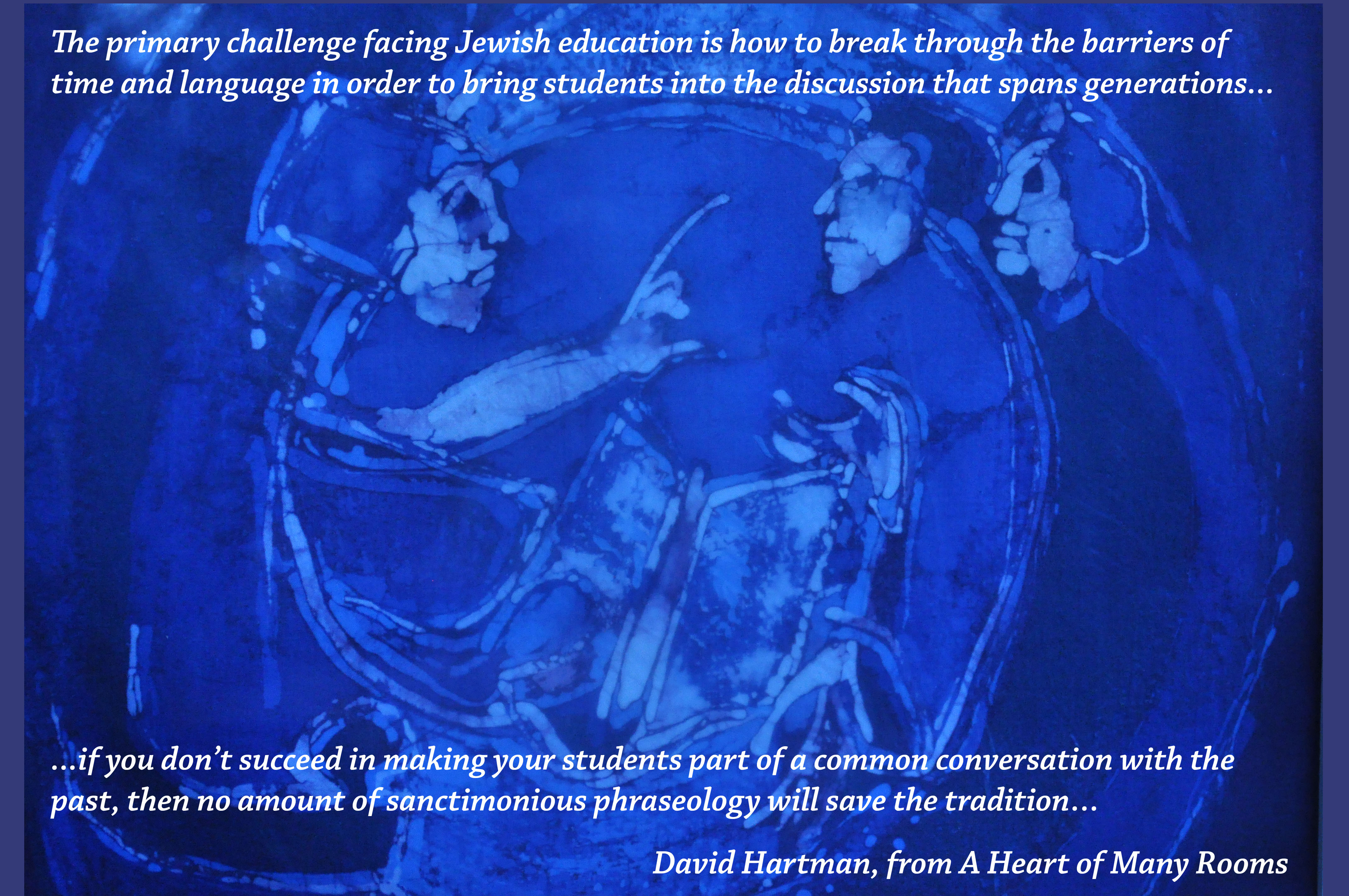
…a memorial between your eyes (Exodus 13:9)Click image for conversation between David Hartman (z"l) and the sages.

During what turned out to be Rabbi David Hartman’s final lesson in his beloved summer Rabbinic Torah Seminar, he shared a personal prayer that he would offer while putting on his tefillin:

Ribbono shel olam [Master of the World], stay with me while I put on my tefillin. Don’t let my mind get distracted. I need You, and above all, I want You.

Herein, a greathearted and passionate teacher offered to his students a prayer that rose from the deepest part of his aging self to the highest expression of his commitment to the living covenant between God and the Jewish people.

Ribbono shel olam [Master of the World], stay with me while I put on my tefillin. Don’t let my mind get distracted

Here was a model for aging and engaging:  In the presence of frailty, seek each day to enlist coherence of mind and body in the service of the living covenant. Tie the covenant to your arm; crown your thoughts with it. Make the leather ring of engagement around the finger and say:  I betroth you to me forever…with righteousness and justice… with faithfulness and with deep knowing of the Lord.

(Click here for verses in Hebrew and English)

I need You, and above all, I want You

David Hartman taught with passion that the covenant flourishes in the presence of love for the Partner—a love that must be realized in deeds. Tefillin—bound to betrothal and deep knowing—constitute a sign of love that insists upon a life beyond beautiful abstraction. For a covenant that must live in the world of deeds, Bind these teachings upon your hand and let them be a reminder between your eyes is an idea transformed through loving imagination into straps, scrolls, and boxes. Tefillin make an impression on the arm and on the mind.

Ancient sages imagined that God also expressed covenant partnership by putting on tefillin. Rabbi Yitzhak said:

From what verse do we learn that the Holy One puts on tefillin? From the verse:  The Lord has sworn by his right hand, by his mighty arm (Isaiah 62:8). By his right hand, means Torah… By his mighty arm, means tefillin…

One sage asked another:

What is written in God’s tefillin? The other answered:  In God’s tefillin is the verse:  Who is like you, O Israel, a people unique/ehad in the world?! God says:  You have made me your only one/ehad in the world by saying, Hear, O Israel, Adonai is our God, Adonai alone/ehad (Deuteronomy 6:4). So do I declare you to be my only one/ehad…

(Click here for the Talmud passage in Hebrew and in English)

Bound together by the tefillin, God and Israel strengthen one another in their covenantal bond. God makes it possible for Israel to bind itself to godly ways. Israel’s covenantal deeds make God manifest in the world.

The great Hebrew poet, Saul Tchernikovsky offered a dramatically different understanding of tefillin. The poet lamented that Israel’s mighty God had been bound by a lifeless ritual:

The God of astounding wildernesses,
the God of those who conquered Canaan in a whirlwind,
was then bound by that people with the straps of their tefillin.

(Click here for the poem excerpt in Hebrew and in English)

For David Hartman, a champion of the living covenant, tefillin do not bind divine power but rather secure it; not smaller, but finer. Not only God is strengthened by tefillin, but Israel is dignified and strengthened as well. Tefillin secure boundless vision to finite carriers.

David Hartman taught that even when the body is failing, the covenant is unfailing. To put on tefillin is to give God a hand in the world.

When I put on tefillin (phylacteries) and pray in the morning, it is not human grandeur that is being acknowledged but rather human vulnerability and imperfection. I can love God and sense God’s acceptance of me as a weak, finite human being. I am a “commanded one” within the context of human limitations.

 The covenant thus signifies the restored dignity of the concrete and the finite. It expresses the ability to love in spite of human limitations, to build meaning in the face of death, to act today without certainty about tomorrow. (David Hartman, ­A Heart of Many Rooms)

Posted in Poetry, Prayer, Talmud | 2 Comments

Monumental Presence

(In memory of Talia Agler)

The solace of a gravestone is its solidity—a feature carried in the Hebrew word matzevah, meaning “firmly fixed.” But a gravestone need not merely be a solid surface that reflects the past. It can be a dynamic, translucent summons to the future. On this point an ancient story and a modern poet are in agreement.

Rachel died and was buried on the road to Ephrat— now Bethlehem. And Jacob affixed/vayatzev  a fixed marker/matzevah on her grave which remains the fixed marker/matzevet of Rachel’s grave to this very day (Genesis 35:19-20).

When the 2nd century sage, Rabbi Shimon ben Gamliel, reflected upon this verse, he deliberately avoided the term matzevah that is so well fixed in the story. Rather, he employed a term of very different character:

Rabbi Shimon ben Gamliel taught: One need not make nefashot/grave stones for the righteous. Their words and deeds are their memorials.

Nefesh certainly means grave marker, but it paints this meaning from a very different palette than that of matzevah.

Primarily, nefesh is the breath and as well as the breath’s passages: Save me, O God, for the waters have reached my nefesh, says the Psalmist (Psalm 69:2) when the waters have risen to his nostrils.

Nefesh is also the spirit (Latin for breath) which breath animates.

God, as well as the slave, draws a deep and in-spired breath—va’yinafash—on the Sabbath (Exodus 23:12; 31:17).

These are the shades of nefesh as distinct from matzevah. Matzevah confirms fixity. Nefesh suggests breath and spirit, animation and rest. Rabban Gamliel teaches that the words and deeds of the righteous are their true monumental presence—features of the soul more than fixtures in the soil.

Another voice in the ancient conversation honors both the fixed matzevah of the biblical verse as well as Rabban Gamilel’s breathing nefesh of word and deed:

Another way of considering the matter: What did our father Jacob perceive that made him bury Rachel on the road to Ephrat? Our father Jacob foresaw that future exiles would pass through that place. Therefore he buried her there in order that she might pray for mercy on their behalf, as it is written:  A cry is heard in Ramah—wailing, bitter weeping—Rachel weeping for her children. [She refuses to be comforted for her children who are gone. Thus said the Lord: Restrain your voice from weeping, your eyes from shedding tears.  There is a reward for your labor—declares the Lord. They shall return from the enemy’s land.  And there is hope for your future—declares the Lord:  Your children shall return to their country.] (Jeremiah 31:14-17)

(Click here for the Midrash in Hebrew and English)

Why was Rachel buried on the road to Ephrat, rather than in the famous family plot close by in Hebron?  In a prophetic moment, Jacob foresaw that a gravestone, a matzevah, fixed here would transform this road into a corridor of comfort and hope for Rachel’s children on their way to exile. This fixed place would summon the cries of Rachel still heard by Jeremiah as the exile fromburned Jerusalem began.

The matevah and the nefesh—fixed and fluid, stone and breath, soil and soul—were joined together on the road to Ephrat; not merely characters engraved, but character imparted, as the verse says, to this very day.

The Israeli poet, Yehuda Amichai, might have agreed that the best features of matzevah and nefesh can be joined:

In my life are many windows
and many graves.

Sometimes they exchange
roles:
then a window is closed forever
then by way of a gravestone
I can see
very far.

(Click here for Amichai’s poem in Hebrew and English)

Posted in Memory, Midrash, Poetry | 1 Comment

“Pleas” Knock

That place, just above the latch
to the left
that no one has or ever will touch
the place hidden, on which no one has laid a hand
the place that does not know how to ask-

It is the place that draws Rivka Miriam’s poetic gaze. The door is only a backdrop. The place is “the essential poem at the center of things,” as the American poet Wallace Stevens said. The place is its own poem waiting to be spoken. The place is Mysterious—hidden, yet in plain view just above the latch to the left. Despite all of the knocking pleas for entry, that place remains untouched.

The Place/HaMakom is an ancient Hebrew name for God. The place that is forever untouched, the place hidden in plain sight, is not only on the door but also beyond it.

God joins the image, and meaning deepens:  It is not only the place on the door that is limited by untouched hidden-ness. God, The Divine Place/HaMakom, is likewise limited. Both the place on the door and the place in the divine are innocent of touch and knock; neither has learned how to ask. Neither one knows how to resoundingly carry forward a plea. Both the place and The Divine Place await those who knock.

The “essential poem” burns itself into the grain of the door and opens to the inner and outer realities that make the poem true. The inner truth is that the poet and all seekers contain an inner place, forever hidden and untouched–a place which has not learned to ask.

The Divine Place/HaMakom is the outer truth–a place to which we have not yet brought our pleas.  The inner and the outer places are forever/l’olam and also hidden/ne’elam. They are features of the world/olam in which all dimensions are real at the same moment.

Images of the place within, among, and beyond make special sense during the time between Rosh HaShannah and Yom Kippur when reflective seekers look for the place un-knocked, untried—the place where (like the fourth child at the Passover table) we do not know how to ask. This place, which we seek each year, forever abides in the cluttered obscurity of plain view.

The place awaits our search. If we don’t find the place, then the door, the divine, and the seeker will never learn how to ask. The Yom Kippur prayer, Ya’aleh, urges seekers to keep knocking:

May our knocking arise at evening
our rejoicing come with the morning
our pleas be favorably received ‘til nightfall
.

(Click here for Rivka Miriam’s poem and the Yom Kippur prayer in Hebrew and English)

Posted in Days of Awe, Holidays, Poetry, Prayer | 2 Comments

Raised, Not Razed

Here in a place where a ruin wants once more to be
a new house, its desire increases our own….

Everything here is busy with the work of remembering:
the ruin remembers…

(Click here for complete Amichai poem in Hebrew and English)

The poet, Yehuda Amichai, lived in Jerusalem, a city that is always learning how to live among its ruins. Are ruins the wrecked and violent tumble of a paralyzing past? Can they become the strong foundations of a propelling future? Living among the ruins of Jerusalem is a project as old as destruction:

Rabbi Yosi said: Once I was traveling and I entered one of the ruins of Jerusalem to pray. Elijah, always remembered for the good, came and waited for me at the entrance until I had finished my prayer.

After I finished my prayer, he said to me: Shalom alecha/peace be upon you, my master! I answered: Shalom alecha, my master and my teacher! He said to me: My son, why did you enter this ruin? To pray, I replied.  Said Elijah: You should have prayed on the road.  I was afraid, said I, lest the passers-by interrupt me. He said to me: You should have prayed a shortened prayer.

And so I learned three things from him:  I learned that one does not enter a ruin. I learned that one prays on the road, and I learned that one who prays on the road prays a shortened prayer.

My son, Elijah continued, what sound did you hear in that ruin? I told him: I heard a heavenly voice cooing like a dove and saying:  Woe to the children on account of whose sins I destroyed my house and burned my Temple and exiled them among the nations!

By your life and breath, said he, it is not only in that moment that she cries so. It’s three times every day that she coos like a dove: wooo, wooo, woe to the children… And not only that, but whenever Israel enters its synagogues and study houses and recites: Y’hei shemei hagadol m’vorach/May his great name be blessed, the Blessed Holy One, shakes his head and says:  Happy is the king who is thus praised in his house! What a thing for the father who banished his children to hear! Woe to those children who are banished from their father’s table!

(Click here for Talmudic story in Hebrew and English)

Modify your prayer in order to pray on the beaten path, Elijah advised.  Yet, the prophet insisted that Rabbi Yosi attend to that which he could only have learned in the ruins. There is divine ambivalence in the world—regret along with resolve, pride, despair, and hope together in the same ruined house:  Happy is the king who is thus praised in his house! What a thing for the father who banished his children to hear! Woe to those children who are banished from their father’s table!

Whether in Jerusalem or in our own environs, perhaps the beaten path is better—for most days.  But we need a hero like Rabbi Yosi who can enter the ruins. We also need Elijah, always remembered for the good, who prompts us to discover that here in a place where a ruin wants once more to be a new house, its desire increases our own….

One participant at the 2012 Sicha Shabbaton took his own place in the conversation as he related the ancient story to a recent profound family loss:

I propose that Elijah somehow entices, pulls or even forces Rabbi Yosi into the ruins. Elijah exposes Rabbi Yosi to a place of ruin, rather than allowing the good Rabbi to continue on a relatively easy path with minor blips. In this place, in these ruins, he is exposed to expressions that anger, that challenge and even inspire him.

When we enter the ruins in pursuit of meaning, we might succeed in affirming the poet’s claim:

Everything here is busy with the work of remembering:
the ruin remembers…

Ruins are to be raised, not razed.

Posted in Elijah, Jerusalem, Poetry, Prayer, Talmud | Leave a comment

Sicha Shabbaton 2012

Sicha celebrated its most successful Shabbaton yet, as we studied about Elijah, the Prophet.  By the time our Shabbaton community bade farewell to Elijah on Saturday night, he had become a presence more alive to us and within us.  Join us for next year’s Shabbaton in the Mountains!

Posted in Elijah, Shabbat | 1 Comment

Yerushalayim: A Pronounced Hope

The name, Jerusalem/Yerushalayim, evokes meaning beyond what the word can contain.  Since ancient times, what sounds like the dual plural ending of her name—ayim—has suggested that she is, after all, two cities. She is real estate and also unreal, a pristine city above and a worldly city inhabited below.

Yerushalayim is two cities in a single word.  Her name is a pronounced hope that the city above will one day be joined to the city below; joined in fact as they are joined in name.

How shall the two cities become one? Does one bring heaven to earth or earth to heaven?  One ancient text asserts:

Said the Blessed Holy One:  I will not enter the Yerushalayim that is above until I have entered the Yerushalayim that is below.  And is there a Yerushalayim above?  Yes, as it is written: Yerushalayim built up, a city knitted together (Psalms 122:3).

(Click here for the Talmudic text in Hebrew and English)

The Israeli poet, Yehuda Amichai, felt burdened by this interpretation of his beloved city’s name:

Why is Yerushalayim always two, one above and one below?
I want to be in the middle Yerushalayim
without banging my head above and without stubbing my toe below.
Why is Yershalayim always in pair language like hands/yadayim and feet/raglayim?
I want to be in a single Yerushal,
For I am merely I and not I-yim.

(Click here for the Amichai poem in Hebrew and English)

Amichai wanted to live in a city unencumbered by the stumbling blocks of history below and by the many idealized futures always hanging insistently and threateningly overhead.

The poet might say:  Let the city be one in which I can live committed to each day, not to the earliest days or to the end of days.  Would that not be heavenly enough?

Posted in Jerusalem, Poetry, Talmud | 3 Comments

The Fragrance of Paradise

Rabbah bar Abbuha met Elijah standing in a cemetery. He cried to Elijah:  I am too poor to take time for learning as I would like. Elijah led him into the Garden of Eden and said to him: Take off your cloak and gather in it some of the leaves. As Rabbah left, he heard a voice saying: Who would consume his portion in the future world as Rabbah bar Abbuha has done? Frightened, he shook out his cloak and scattered the leaves. Yet, since it had carried the leaves of Paradise, his robe had absorbed their fragrance. He sold the robe for twelve thousand dinars—a legacy for his children. Rabbah left the cemetery richer than when he had entered. (Paraphrased from Babylonian Talmud, Baba Metzia 114a.)

There are no longer many who knew David, the 94 year old who had just died. For many years, he had lived in another town. It was mainly the members of the Hevra Kaddisha, the Burial Society, who awaited him and his family at the cemetery as they made the long trip back home to where David had grown up with seven siblings.

The hearse arrived followed by a large procession of family. With a simple burial, David would be back with three generations of his family. We walked slowly from the cemetery gates to the grave—family pallbearers handing off the honor to the Hevra Kaddisha after we had halted seven times along the way. The Hevra Kaddisha bent to the task of lowering the coffin, but no maneuvering could compensate for the narrow grave.

Elijah the prophet reminds us that in the cemetery, Paradise is only a step away. In cemetery terms, the grave was not big enough. In Paradise terms, before us was a life that could not be contained by this grave.

We entrusted David to the care of the Hevra Kaddisha and we proceeded to visit family graves of three generations. With each stop, we brought new stories to life:  The location of Mama’s grave proclaimed her prominent role in the Hevra Kaddisha. Papa had died on her birthday—a forgotten drama restored by a close reading of grave stones.

Not far away from Papa’s grave was the grave of David’s grandfather, Jack. This gravestone offered another treasure, this one from the ancient family album. Jack’s Hebrew name, Ya’akov, was spelled with a vav carrying the weight of the “o” vowel instead of the accepted, leaner spelling in which the vowel is only implied. In cemetery terms, his name was misspelled—there was one character too many. But in Paradise terms, the stone has an enriching character.

An ancient teacher observed that the name Ya’akov appears with the vav five times in the Bible. Just so, the name Eliahu, is spelled only five times in the Bible without a vav—not Eliahu, but Eliyah, the prophet Elijah. There is an ecology of sacred letters. A letter missing from here must turn up there—and with a purpose. Whether referring to our biblical grandfather or David’s grandfather, the name Ya’akov-With-A-Vav carries a bit of Eliahu, the prophet and imparts the fragrance of a future beyond the cemetery in which all stories and the lives that carried them live and prosper.

Now, we returned our attention to the grave too narrow and the life too big. A lithe, powerful grave digger was finishing his work. His pick arced around a focused face that betrayed neither age nor fatigue. When he stopped, members of the Hevra Kaddisha reached their hands towards him and pulled him out of the grave—a Paradise moment brought to life in the cemetery. The grave digger stood nearby, breathing easily and watching as the Hevra Kaddisha lowered David’s coffin.

Now, the grave digger raised his hand to the family and said:  “I offer the family my condolences. I hope that the delay did not disturb you and that you take the best of him away with you.” Then, he turned and walked off.

I had thought about asking the grave digger his name. But I did not do it because Elijah often prefers disguises.

Posted in Elijah, Talmud | 4 Comments

Between the Mountain and the Moment

The last words of the Ten Commandments resound from Sinai and the narrative of revelation continues:  All the people saw the thunder and the lightning, the blare of the horn and the mountain smoking; and when the people saw it, they fell back and stood at a distance (Exodus 20:15). Modern translators, wanting to align the senses, retreat from the awkward verb by saying:  All of the people perceived the thunder and the lightning.

One ancient version of the sacred text (the Samaritan Torah) sorts out perception by saying:  All of the people heard the thunder and saw the lightning.

Rabbi Ishmael, a sage of the 2nd century, addressed this verse’s confusion of the senses:  They could see that which was visible and hear that which was audible.  For Rabbi Ishmael, the Torah speaks in human language; reason draws the line between the literal and figurative. One can only see that which is see-able.

His colleague, Rabbi Akiba, disagreed. Rabbi Akiba said:  They could both see and hear that which was visible. When God spoke at Sinai, Akiba insisted, senses overflowed their banks; sight and sound inseparable.

(Click here for biblical text and midrash)

The Israeli poet, Rivka Miriam, expanded Rabbi Akiba’s view to include all of the senses:

A semblance of mountain returned to Sinai
even as the visions remained in Moses’ ears, and in his eyes the shofar and thunder sounded still

and the sixty myriad of their faces were still buried, trembling against his chest

touch still in their nostrils, taste still in their hands

and then, like opening a sack or a purse, the Torah loosened her knots before them

with her letters slowly blotting confusion from their expression, as with a kerchief
.

(Click here for Rivka Miriam poem in Hebrew and English)

As the divine words fade, the people are fearful and confused in the presence of a revelation too deep and high for individual senses to hold; vision resounds, smell and taste elaborate touch. The mountain had expanded to become a moment. Only now, as the poem opens, does the mountain begin to regain its former state. As each sense reclaims its own way of knowing, an unexplainable wholeness becomes only the sum of its many parts.

Torah takes her place precisely here, where the more and the mundane meet, where the meta and the physical join. Precisely now she opens her sack, her purse. With her letters, she blots away confusion and becomes the text that mediates between the mountain left behind and the moment to be met.

Posted in Holidays, Midrash, Poetry, Torah | 3 Comments

The Perfect Search

The Mishnah describes how we conclude the search for leaven on the eve of Passover eve:

With the last light of the fourteenth of the month, we search out the leaven by the light of a lamp.  Any place where we do not bring leaven does not require searching…

We need not worry that a weasel has dragged something leavened from one house to another or from one place to another.  For if this were so, it could have been from one courtyard to another or from one town to the next and the matter would have no end.

(Click here for the mishnah in Hebrew and English)

The ancient text brings to light and addresses a very real worry:  It is possible to become obsessed with the Torah’s commandment to remove all leaven from your homes (Exodus 12:15).  

Here, on the eve of Passover eve, the ancient text describes a ritual that redeems us from endless search, or else the matter would have no end.  We would be endlessly enslaved to the commandment.  Going forth from the obligation/ y’tziah mi-y’dei chova sets the stage for going forth from Egypt/ y’tziah mi-Mitzrayim.

As daylight gives way to lamplight, the final search for leaven is not a scrupulous hunt in the bright sun of clear distinction.  In the end, it is the shadow that reveals, in our day, a few pieces of bread strategically hidden so as to be found.  More for the soul than for the search, this is an act of both obedience and freedom.  We have done the best that we can; there must be an end in order to make a beginning.

We declare closed the search for leaven, but the “yeasty” symbol of a candlelight quest continues to rise into new meaning.

The poet, Yehuda Amichai, watched his father light his lamp from the Mishnah’s flame and search his way into parable:

Last evening I gave you a parable
of my father who on the eve of Passover eve
would cut bread with precision
into exact cubes and put
them on the window sill so that he would be able
to find them with his heavy eyes
by the light of a candle dancing mitzvah dances
so that his blessing for burning the leaven not be
in vain.

This is how we live:
directors of our selves
deceptive directors
with perfect faith, almost,
so as not to be
in vain.

(Click here for the Amichai poem in Hebrew and English)

The evening search is contrived—but not beyond belief.  By candlelight we, along with the poet, learn from practice and parable the well rehearsed act of nullifying the leaven while leaving the drama intact.  Such is the nature of perfect faith, almost.

Posted in Poetry | 3 Comments